Orca: A New Kind of AI That Learns How the World Works by Watching
Beijing's BAAI released Orca, a 'world model' trained on 125,000 hours of video that matches specialized robotics systems — without ever seeing a labeled robot action during pre-training.
The Beijing Academy of Artificial Intelligence (BAAI) has released Orca, an AI model built on a different idea than the chatbots you know. Instead of predicting the next word in a sentence or the next frame in a video, Orca predicts the next state of the world — an abstract internal picture of what’s about to happen. And it holds its own against specialized robotics systems, despite never seeing a single labeled robot action during its main training.
Orca learns in two ways. The first, which the researchers call “unconscious learning,” is watching: 125,000 hours of raw, unlabeled video, from which the model picks up how scenes typically change — how objects move, what happens when something gets covered up. The second, “conscious learning,” adds language: videos chopped into segments, each labeled with a description of what action caused what change. Both feed the same internal picture of the world. On top of that frozen core sit small, swappable output modules — one produces text, one produces images, and one (called Action Expert) produces robot movements.
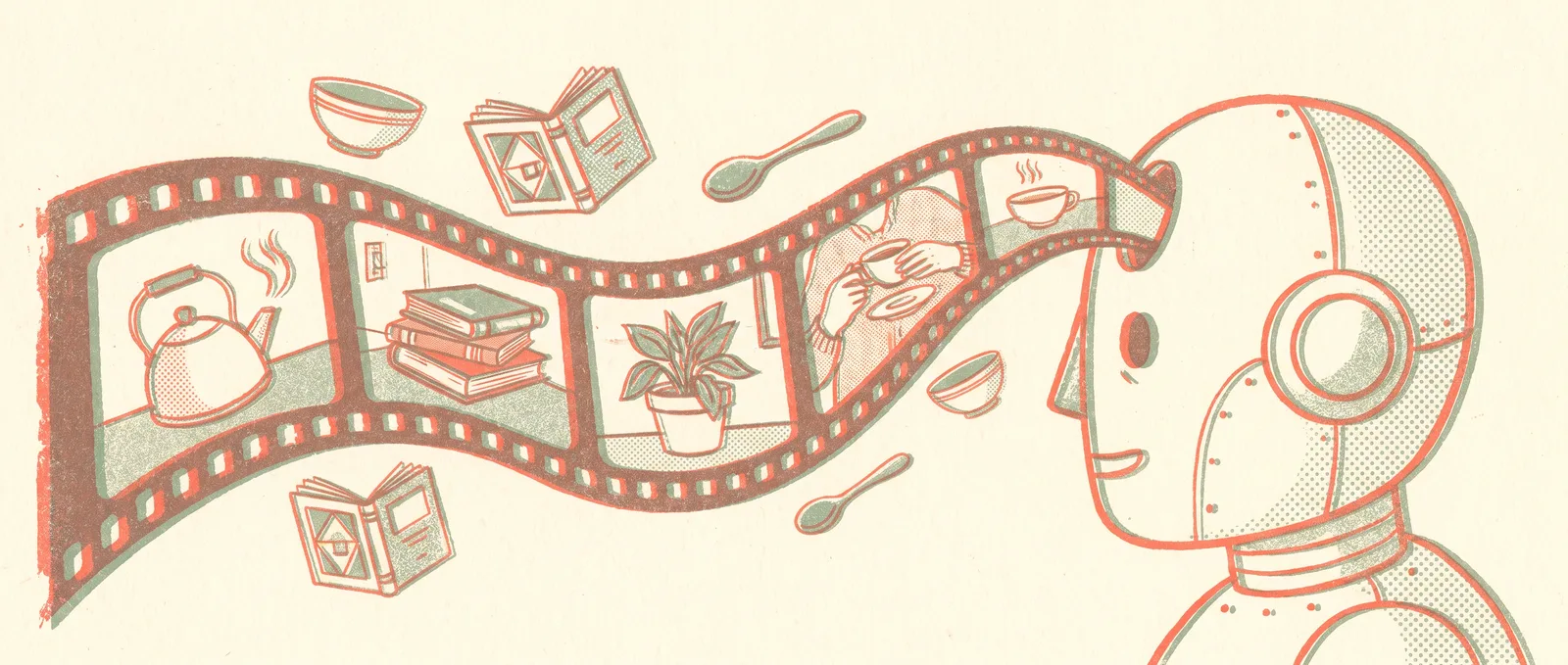
The results are the interesting part. In five real-world manipulation tasks with a two-armed humanoid robot — shelving books, stacking bowls, scooping sugar — Orca matches π0.5, a system built specifically on robot data. The robot-control module only needed 200 recorded demonstrations per task afterward. The paper even shows Orca recovering from failed grasps and retrying, while the specialized system got stuck repeating the same mistake. On image prediction (“show me what the scene looks like after the microwave is closed”), it beats dedicated image generators.
What’s behind this? Robotics has a chronic data problem. Language models can gorge on the entire internet, but there’s no internet-sized pile of labeled robot actions — collecting them is slow and expensive. If a robot’s understanding of the world can come mostly from ordinary video, with just a small dose of robot-specific training on top, that bottleneck loosens considerably. Worth keeping expectations grounded, though: Orca is small (0.8 and 4 billion parameters), it can’t hear or feel touch and force, and the research community still argues about what a “world model” even is. This is a promising direction, not a finished product.
What this means for you: Nothing to install today — this is research. But it’s a window into how AI gets from screens into the physical world: not by scaling chatbots, but by models that learn cause and effect from watching. If capable household and warehouse robots arrive in the coming years, approaches like this — trained on video rather than millions of hand-labeled robot actions — will likely be a big part of why.
Sources
Source: https://arxiv.org/abs/2606.30534
An AI Just Proved a Math Problem That Stumped Humans for 50 Years
OpenAI's GPT-5.6 Sol Ultra reportedly proved the Cycle Double Cover Conjecture in under an hour. A mathematician calls the proof 'very nice' — and points out what the announcement leaves out.