You Can Now Hire a Humanoid Robot to Clean Your Flat, With a Human in VR Goggles Driving It
Tau Robotics opened an invite only pilot in San Francisco at $30 an hour. The robots vacuum and take out the bins. They also cannot climb stairs, and a person is steering most of the time.
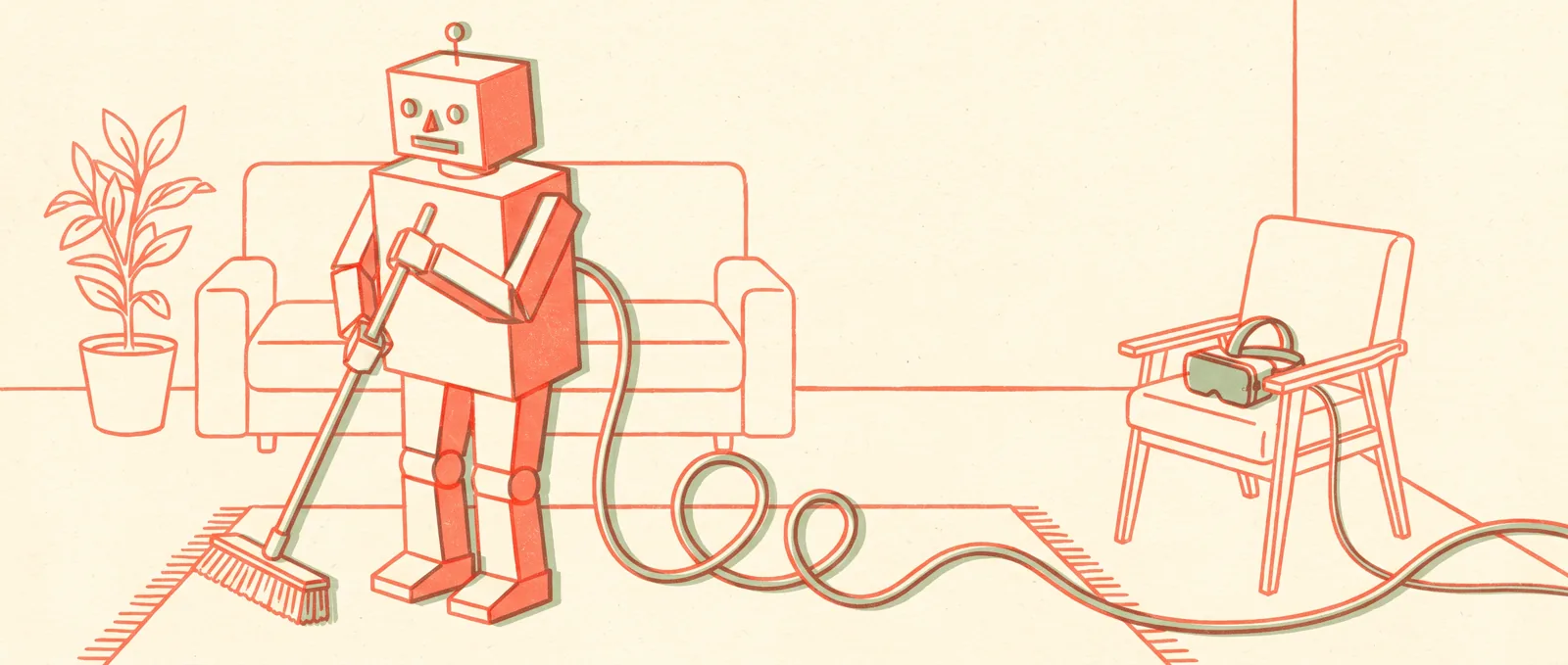
Tau Robotics has started letting San Francisco residents hire humanoid robots to clean their homes for $30 an hour. The pilot is invite only, the machines cost around $50,000 each, and they have names: Chelsea, Elon. They wear little black Tau Robotics uniforms. CEO Alexander Koch announced the launch with live footage on X, and the company says it wants to reach 1,000 cleanings a week in San Francisco by 2027, then other US cities and international markets by 2028.
Now the part the footage does not show. The robots are mostly driven by people. Human operators sit at a central hub wearing VR goggles that let them see through the robot’s cameras and into your home, and they steer it through the job. Onboard AI helps with smaller movements and adjustments, but the intelligence doing the actual cleaning is largely a person in a headset somewhere else. The robots vacuum, wipe kitchen counters and take out the rubbish. They cannot climb stairs.
Ken Goldberg, a robotics professor at UC Berkeley with four decades in the field, was blunt about the state of the art: “I really think it is too early,” he said, adding that he would be very surprised if these machines could do anything close to a useful job of cleaning a house. He also raised a practical safety point that is easy to overlook in a promo video. These are heavy units moving around a home with people in it, and a fall or a collision is not a small thing. Goldberg’s estimate for robots that reliably clean houses on their own is about a decade away.
So why launch now? Because teleoperation is not a cheat, it is the training pipeline. Every hour a human drives a robot through a real kitchen generates exactly the kind of messy, real world demonstration data that these systems need to eventually do it alone. The business model in the meantime is that customers pay for the data collection. That is a reasonable strategy and it is also worth naming clearly, because “AI robot cleans your home” and “remote worker operates a robot in your home, supervised by some AI” are very different sentences, and only one of them is happening today.
What this means for you: for now, nothing, unless you live in San Francisco and fancy being an early tester. The useful thing to take from this story is a habit rather than a product. When you see a robotics demo, ask who is actually in control. Teleoperation, remote supervision and human intervention are standard in this field and rarely mentioned up front. The second thing to sit with is the privacy question, which is genuinely new: a stranger wearing VR goggles gets a live camera feed through your flat. That may well be fine and consented to, but it is a different arrangement from a cleaner with a hoover, and it is worth deciding how you feel about it before the service reaches your city.
Sources
Source: https://www.cbsnews.com/news/tau-robotics-humanoid-ai-cleaning-robots-san-francisco/
One Researcher, Under 20 Prompts, One Day: How AI Built a Zoom Attack
A Security disclosed three critical Zoom flaws on August 11. The bug is bad enough, but the finding is the cost: work that used to take nation states months took a single researcher a day.