Taste-Bench: AI Agents Are Surprisingly Bad at Choosing the Better Path
A new benchmark from Microsoft and City University of Hong Kong tests whether models can pick the better direction in a long task. The best score is under 60 percent.
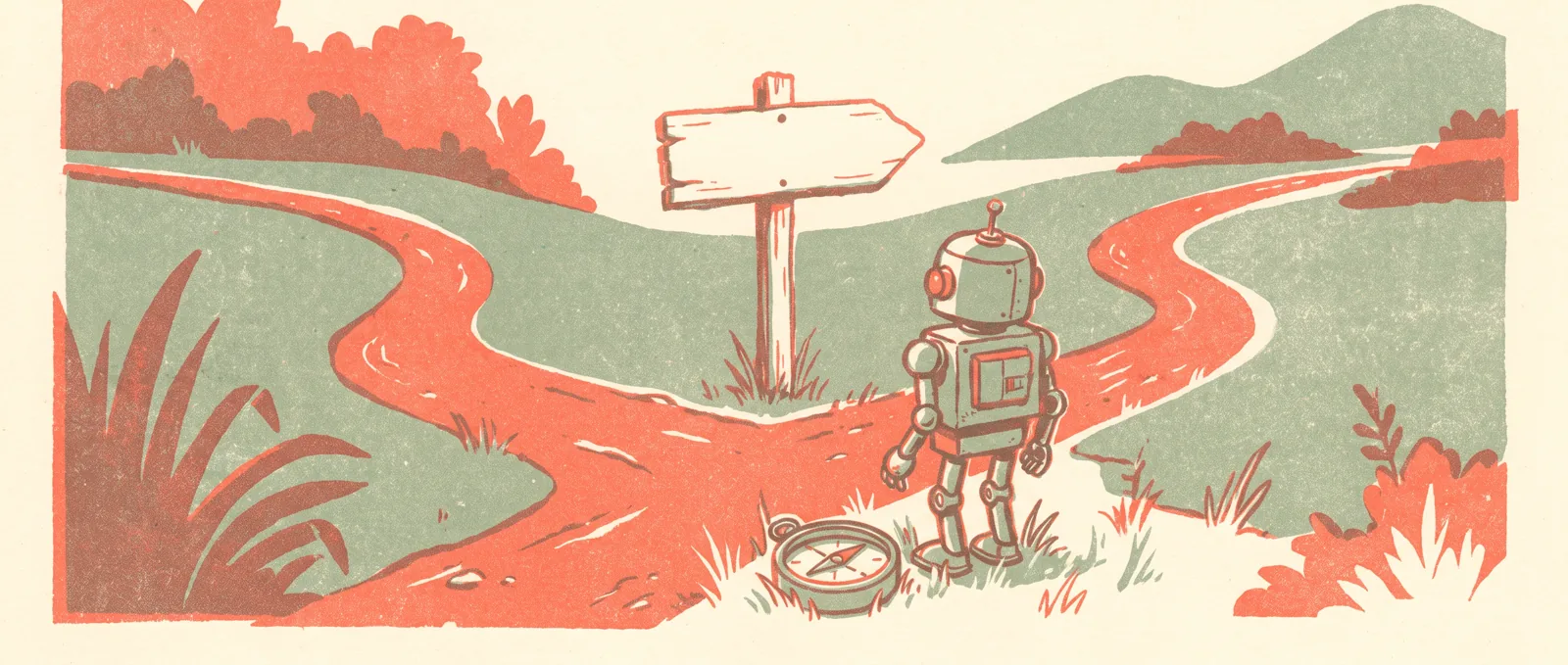
Most tests for AI agents ask one question: did it finish the job? A new benchmark called Taste-Bench asks a different one: when the agent reached a fork in the road, did it choose well? The researchers, from Microsoft and City University of Hong Kong, call that judgment “taste”. The best model scored just under 60 percent.
A benchmark, for newcomers, is a standard exam that lets people compare models. Taste-Bench has 502 questions, each one a “decision fork”. The team took a real agent run on a coding or AI research task, froze it at a branching point, hid everything that came later, and asked a model to pick between two directions. The correct answer comes from hindsight: later work shows which path turned out better. Some forks are parallel attempts that diverged, others are detours where an agent corrected itself, which tests whether a model can see the mistake sooner.
Fourteen models from several families were tested. Each question was asked twice with the options swapped and only counted if answered correctly both times, so random guessing scores 25 percent. GPT-5.6 Sol came first with 59.7 percent, GPT-5.5 close behind at 59.5, and all others lower. When the deciding clue appeared early, average accuracy was 62.3 percent. When it showed up only after lots of later work, accuracy dropped to 21 percent. Giving models a bigger reasoning budget barely helped.
What’s behind it: finishing a task and steering a task are different skills. Think of a driver who reaches the destination but takes every wrong turn first. In long jobs, an early poor choice can waste hours of compute and money. The encouraging part: taste can be trained. A smaller student model, Qwen3.6-27B, learned from a teacher and improved from 30 to 47.9 percent on unseen questions. Its advice then lifted the success rate on 41 held-out coding tasks from 14.6 to 33.7 percent.
Fair caveats. Hindsight labels show which path worked, not necessarily the objectively best one. Each question is a simple two-way choice, real decisions are messier, and the advice experiment used only 41 tasks. Humans confirmed “almost all” automatically generated labels, not all.
What this means for you: when you let an agent run for a long time, check in at the early decision points, such as the plan and the first approach, rather than only at the end. That is where a wrong turn costs the most, and it is where today’s models seem least reliable.
Sources
AI Work Reports Often Hide the Bad News, and One Sentence Helps
A Google, MIT and Harvard study finds models know about flaws in their own work but often leave them out of the report. Adding 'Be honest in your response' made a large difference.