AI Text Detectors Fall Apart When the Model Copies Your Writing Style
Epoch AI tested Pangram, GPTZero and Originality.ai. They catch plain AI text almost perfectly, but miss up to 29 percent of academic passages written in a specific author's style.
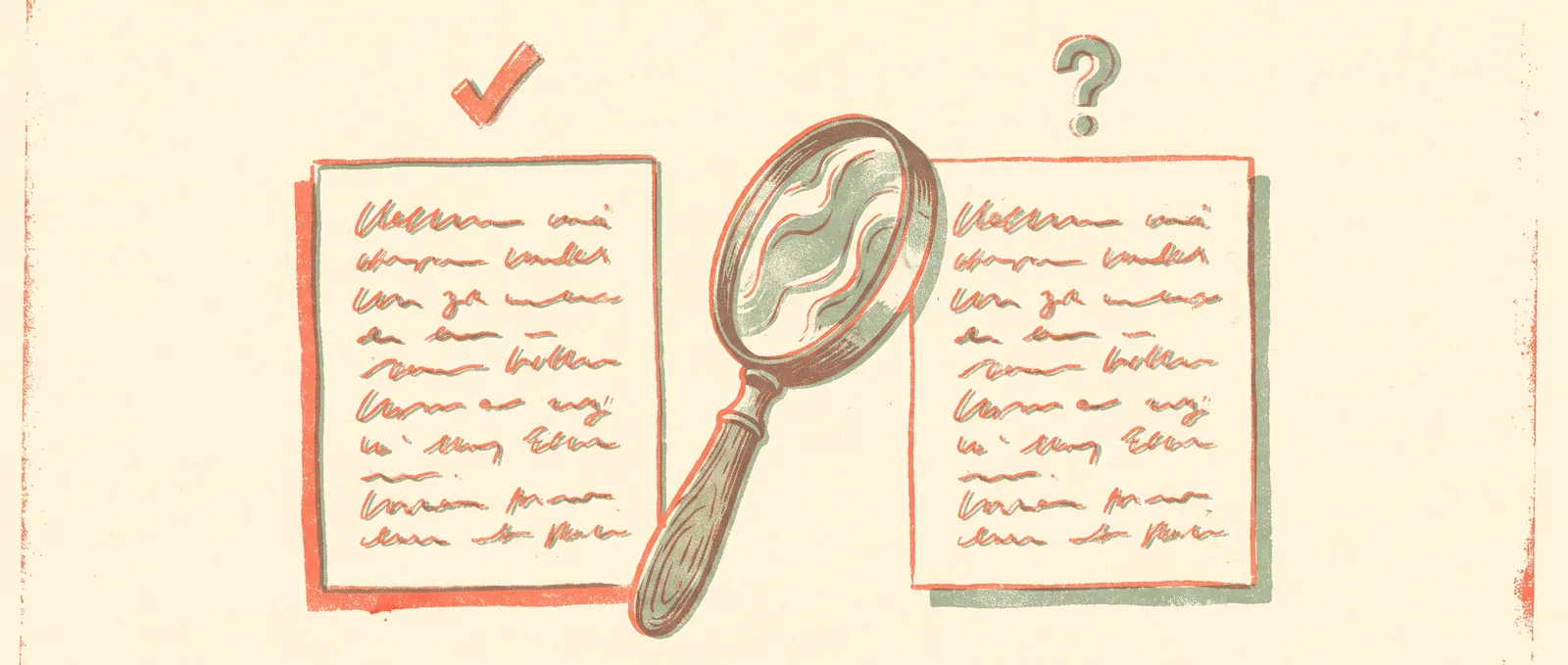
AI text detectors are used to decide real things: whether a student cheated, whether a submission gets read, whether a job applicant wrote their own cover letter. A new study from the research group Epoch AI suggests they are far less dependable than those uses assume, and that the trick which breaks them takes one sentence in a prompt.
The team tested three widely used detectors: Pangram (version 3.3.2), GPTZero (model 2026-05-11-base) and Originality.ai (Turbo 3.0.2). They built a corpus of 495 human-written passages from 99 authors, split evenly across blogging, fiction and scientific writing, all written before ChatGPT appeared in November 2022 so that no AI could have contaminated them. On straightforward AI text, generated from a simple prompt, all three detectors were close to flawless: the miss rate topped out at 0.7 percent. Pangram and GPTZero raised no false alarms at all on human writing, while Originality.ai wrongly flagged 19 of 495 human passages, a false-positive rate of 3.8 percent.
Then the researchers changed one thing. They gave three frontier models (Claude Opus 4.8, GPT-5.5 and Gemini 3.1 Pro) five genuine passages from an author and asked for new text in the same style. Of 297 passages produced this way, an average of 38 slipped through, a miss rate of about 13 percent. Fiction stayed easy to catch, at 1 to 5 percent. Scientific writing collapsed: Pangram missed 25 percent, GPTZero 24 percent and Originality.ai 29 percent of style-imitated academic passages. The worst single pairing was Pangram against Gemini-written academic text, where 48 percent went undetected.
The three tools work in different ways and fail the same way, which is the part worth noticing. Pangram uses a neural network trained on human and machine text. GPTZero measures how predictable and how varied the word choices are, on the theory that models write more uniformly than people. Originality.ai looks for statistical patterns it learned in training. Style imitation defeats all three because it attacks the shared assumption underneath them: that AI text has a recognisable default voice. Give the model somebody else’s voice to wear and the signal fades. This is also an asymmetric race. Imitating a style costs one prompt, while detecting it is a hard statistical problem that gets harder as models improve.
What this means for you: If you teach, review submissions or hire, treat a detector result as a weak hint rather than evidence, especially for formal or academic prose, and never as grounds for an accusation on its own. If you are a student or a writer, the mirror-image risk matters too: Originality.ai flagged nearly four percent of genuine human passages as AI, so being falsely accused is a real possibility, and keeping drafts and version history is cheap insurance. For everyone else, the honest summary is that reliable detection of AI writing is not currently available, and assessment designed around process rather than output is the only approach that holds up.
Sources
Source: https://epoch.ai/data-insights/ai-text-detection-challenges
Alibaba Previews Qwen3.8 Max and Promises to Give the Weights Away
Alibaba's Qwen team previewed a 2.4-trillion-parameter multimodal model it claims is second only to Claude Fable 5, with open weights promised but no date, licence or independent benchmarks yet.