Robots are running out of training data, so one startup is recording brain waves
In a warehouse in San Leandro, Encord pays people to play Jenga while wearing headsets that track their eyes and their brain activity. The bet: the bottleneck for robot AI is not model design, it is data that has to be manufactured rather than scraped.
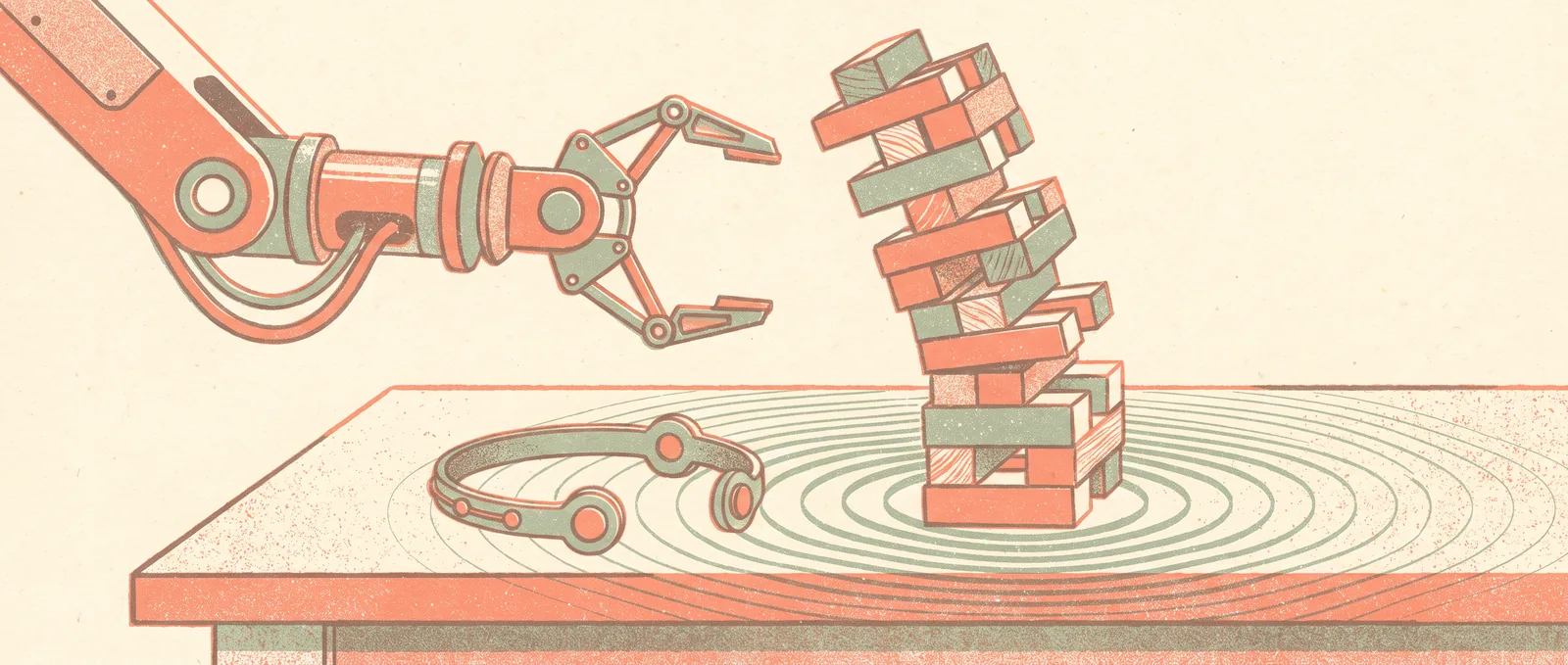
The frontier of robot AI, according to TechCrunch, currently looks like a man playing Jenga in a warehouse. Andrew Ceja works as a pilot at Encord, a company that builds data tooling for AI training, and he pulls wooden blocks from a tottering tower while wearing a headset. A camera tracks what he sees, which is now standard for collecting robot training data. The unusual part is the second set of sensors, which measure his brain waves while he does it.
The headset comes from Zander Labs, a German neuroscience startup. Its bet is that reading brain activity to infer mental states, specifically error, intent and surprise, produces a richer dataset than video alone. Zander neuroscientist Lucas Gehrke says the amount of brain activity a person spends at each moment of a task hints at where a robot will need its highest-effort model and where a cheap one will do. Encord is candid that this is a trial: build a brain-wave-tagged dataset, run it through customer robotics models, see whether performance actually improves, then decide whether to scale. Elsewhere in the same building, pilots use paired robotic arms, one human-controlled and one mirroring it, to generate data on pouring coffee and stacking poker chips. Storage racks hold plastic vegetables, kitty litter trays, and bundles of cables, the everyday clutter a household robot would need to handle.
The reason any of this exists is a wall that keeps stopping robotics. Language models were built by scraping text off the internet, which cost the labs almost nothing. There is no equivalent pile of physical-world data lying around. Encord’s head of robot learning, Vineeth Velmurugan, estimates it would take a dataset roughly five times the size of YouTube’s entire video corpus to break through, and that video alone lacks the fidelity of real-world capture. So the data has to be manufactured. Dense annotation, labelling each clip with descriptions like “right hand tightens bolt,” is worth about a hundred times as much as raw first-person footage for training a specific task, and costs about twenty times more to produce. On paper that is a good trade. In practice, twenty times more is real money, and that difference in economics is the honest limit of the comparison between robot AI and chatbots.
What this means for you: For most people, nothing today, and that is fine. What this explains is why capable household robots keep being a few years away while chatbots got good so quickly. The two are not the same problem, because one had free training data and the other has to pay for every hour of it. If you are watching the field, the signal to track is not the next humanoid demo video but whether data-generation companies like Encord can drive the cost of physical training data down. If you are interested in where new AI jobs are appearing, note that Ceja and his colleague Sofia Infante both came from Scale, another annotation firm. Teaching robots by doing things carefully while wearing sensors is now a job description.
Sources
Source: https://techcrunch.com/2026/07/26/are-brain-waves-the-next-unlock-for-physical-ai/
METR has a new way to ask whether an AI agent is actually cheaper than a person
The evaluation lab proposes the expenditure horizon: the budget at which a human becomes more cost-effective than an AI agent on the same optimization task. In a first test, agents crossed over somewhere between zero and $3,000.