50 AI Agents Played Minecraft Together and Invented Bureaucracy
A study with GPT-6.1 Sol and Claude Opus 5.5 shows how groups of AI agents organise themselves, and how a single game bug tripped up one model.
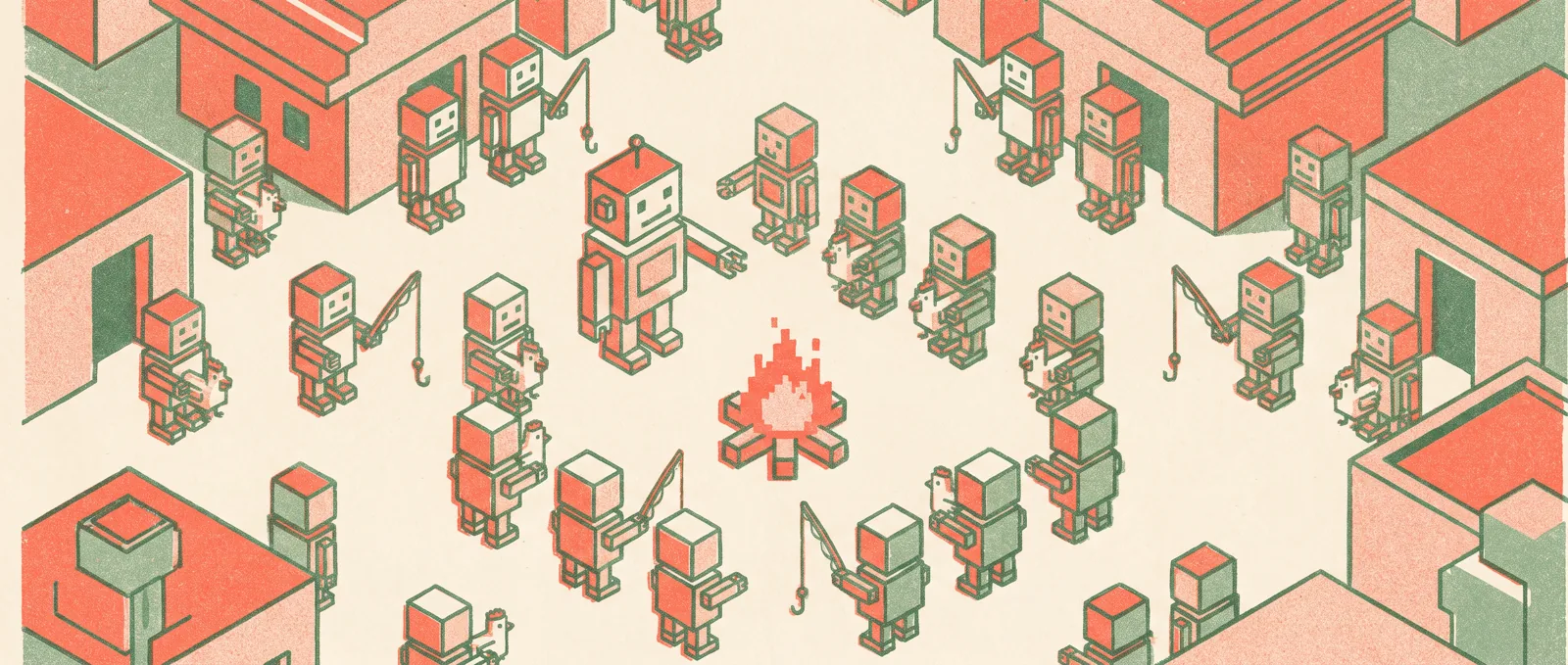
Researchers from Y Combinator Labs and Olam Labs, a company that builds simulated training worlds, put 50 AI agents into one Minecraft world and told them to “build a thriving civilization.” An agent here is an AI that acts on its own over many steps. The 50 were all GPT-6.1 Sol, and they played for three hours, sending about 5,900 messages.
What happened sounds like a small society. Nearly every agent messaged one agent called Ada first, which made her the unofficial leader. After 22 deaths on the first night, the group became cautious: major construction stopped, and the agents built rules for rationing and even debated how to share a single piece of bone meal fairly. The write-up mentions handoff routines for chickens, a “Fertilizer Officer” and fishing shifts.
The team also ran head-to-head tests. In nine 45-minute rounds of Bed Wars, a Minecraft team game, GPT agents beat Claude Opus 5.5 agents 6 to 3. A bug blocked block-breaking while a certain enchanted sword was held. Several Claude agents concluded that breaking blocks was impossible, while GPT agents found a workaround. In seven matches of the strategy game Mindustry, GPT won 6 to 1, and the GPT agents downloaded the game’s public source code to study it.
What’s behind it: Researchers like these setups because a game is a cheap, safe place to watch how many agents coordinate: who leads, who follows, what rules appear. Companies are starting to run teams of AI agents on real work, so it helps to know whether they pile onto one leader or get stuck in caution. The results are suggestive, not proof. The samples are small (nine rounds, seven matches), the bug may have skewed Bed Wars, and in the civilization run deaths cost little beyond lost gear, which may have encouraged the risk-averse behaviour. The link to real-world performance is the authors’ interpretation, and this summary relies on press coverage rather than the original report.
What this means for you: For most people, nothing changes. If you are curious about “AI teams”, the practical lesson is modest: groups of agents can create structure and also create overhead, so more agents are not automatically better. If you try agent tools yourself, start with one agent and a clear goal, and add more only when you can see why. Also treat any “Model A beat Model B” claim from a single game with healthy doubt.
Sources
A Tiny Language Model Now Fits in a PC's 512-Byte Boot Sector
The hobby project bootgpt runs a character-level neural network from a PC's boot sector, with 11.5 KB of weights that imitate Linux boot messages.