A Toyota Spin-Off Built a Humanoid Robot With No Legs, and It's Already Working Shifts
Walden Robotics came out of stealth with around $300 million at a $1.1 billion valuation. Its robot rolls on wheels instead of walking, and one is already doing eight-hour shifts in a Toyota plant.
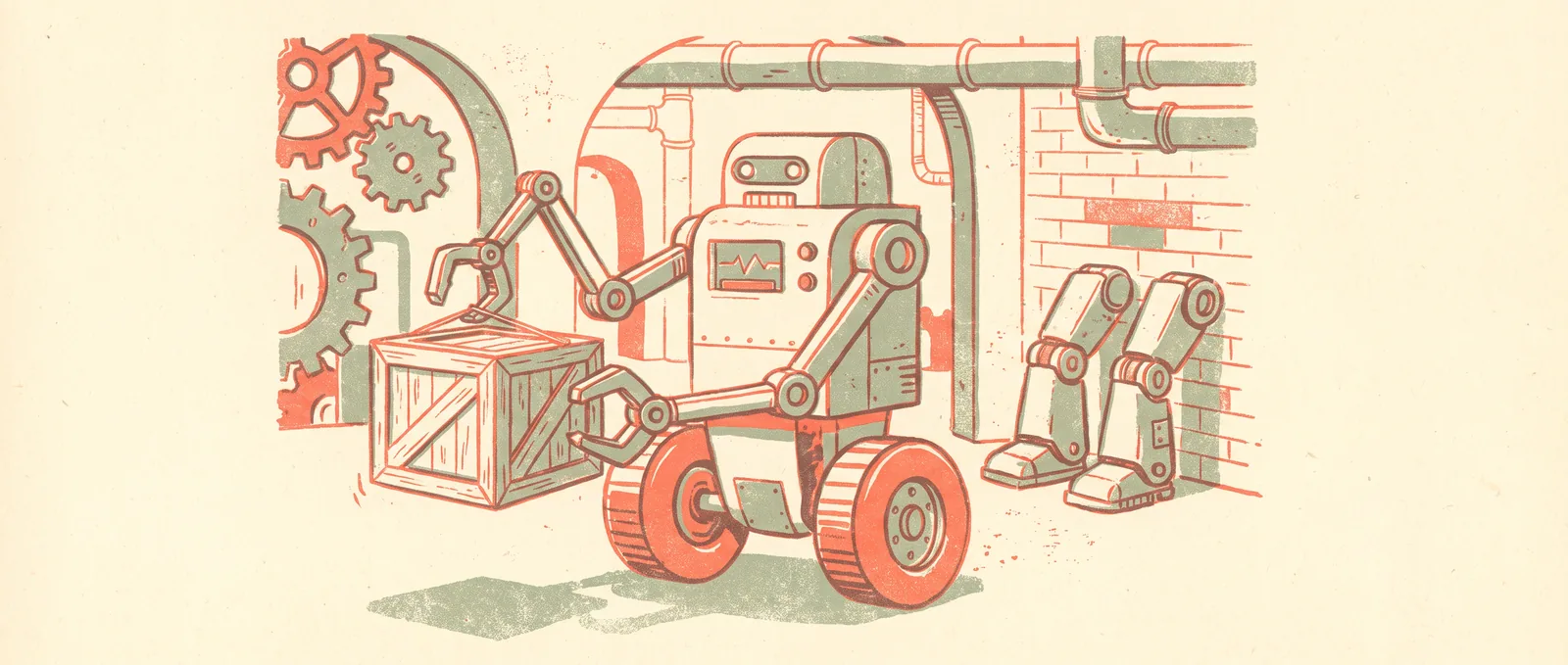
Most humanoid robot demos you have seen involve walking, usually carefully, usually on a stage. Walden Robotics, which just emerged from stealth with roughly $300 million in funding at a $1.1 billion valuation, decided to skip the legs entirely. Its robot has a humanoid upper body, two arms and a sensor-covered head, mounted on a wheeled base. And unlike most of the field, it is already doing real work.
The company spun out of the Toyota Research Institute earlier this year and is based in Cambridge, Massachusetts. The funding round was co-led by Toyota and Deviation Capital, with Nvidia, Boeing, Samsung Ventures and CoreWeave Ventures among the other backers. According to the company, one robot is already running eight-hour shifts at a Toyota plant in North America, loading and unloading car parts, cleaning machinery, and preparing component sets for assembly.
The decision to drop the legs is the interesting engineering call. Walking on two legs is enormously difficult, consumes a lot of power, and mostly buys you the ability to climb stairs. A factory floor is flat. Wheels are cheaper, more stable, more energy efficient, and free up the entire engineering budget for the part that actually creates value, which is the hands and the software that decides what to do with them.
What is behind it: humanoid robotics has attracted a torrent of money this year, and the honest state of the field is that almost none of it is backed by proven economics. Most companies are funded on the promise of general-purpose robots rather than robots that currently pay for themselves. What makes Walden notable is that it inverted the usual order: it has a deployment inside a real factory first and the funding announcement second, with the customer, Toyota, also an investor. That is a much stronger signal than a polished video, though it is worth keeping in mind that one robot in one plant is a pilot, not a business.
The broader shift underneath all this is that AI is moving off the screen. The same kind of model that learned to predict text is now being trained to predict physical actions, which is why chip makers and cloud providers keep showing up on these investor lists.
What this means for you: nothing immediate, and probably nothing for several years unless you work in manufacturing or logistics, which is where these machines land first. What is worth watching is the pattern rather than the robot: repetitive, physically awkward tasks in controlled environments are the first to be automated, while unpredictable environments like homes remain much further off. If someone tells you a general-purpose home robot is around the corner, the honest counter-question is whether it can hold down a shift somewhere boring first.
Sources
Source: https://www.therobotreport.com/walden-robotics-launches-1-1b-valuation-general-purpose-robots/
Apple Is Bringing Its AI to China, Powered by a Chinese Model
Apple got regulatory approval to launch Apple Intelligence in China, but it has to run Alibaba's Qwen model to do it. A clear sign the AI world is splitting into two separate stacks, one Western and one Chinese.